Nobody is likely to finish reading Edgar Allan Poe’s “The Raven” and think, What an upbeat little bird poem.
The poem gives us midnight, sorrow, darkness, lost love, terror, demons, shadows, and a grieving speaker who gradually works himself into despair. Its most famous word is “Nevermore.” Its final image leaves the speaker’s soul trapped beneath the raven’s shadow, apparently forever. And yet, when “The Raven” is analyzed using a word-level valence lexicon, its average valence lands at 0.525 on a scale from zero to one. Because 0.500 represents the midpoint, the result falls slightly on the positive side.
That sounds wrong. It is also exactly the kind of result VerseVAD was built to investigate. The score does not mean that “The Raven” is secretly cheerful. It means that the positive and negative associations attached to its individual words balance differently than we might expect from the poem’s overall atmosphere. Understanding why requires us to look beyond the average and return to the language itself.
First, How Positive Is It Really?
The phrase “positive valence” can make a result sound more dramatic than it is. A score of 0.525 is not an enthusiastic endorsement of life. It is only 0.025 above the midpoint.
The result also remains remarkably stable when the analytical settings change:
| Analysis view | Valence |
|---|---|
| All matched words, token-weighted | 0.525 |
| All matched words, type-weighted | 0.524 |
| Stopwords excluded, token-weighted | 0.528 |
| Stopwords excluded, type-weighted | 0.523 |
Token weighting counts every occurrence of a word, allowing repetition to influence the result. Type weighting counts each unique matched entry once. Stopword exclusion removes many common grammatical words so that content-bearing vocabulary receives more attention.
None of those changes transforms the poem’s profile. The score stays close to 0.525 in every view. Repetition is not dramatically inflating the result, and common function words are not solely responsible for it. The most accurate description, then, is not that “The Raven” looks positive. It looks more balanced at the level of individual word associations than its reputation and reading experience might lead us to expect.
The Words Pulling the Score Upward
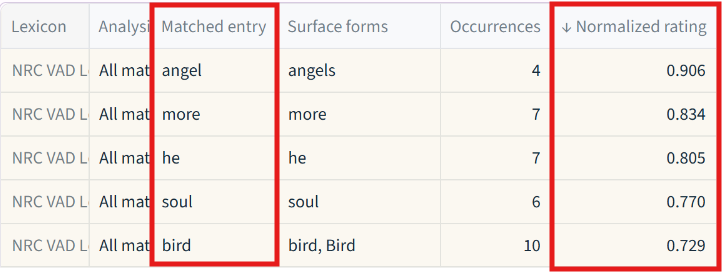
The word-level results begin to explain what is happening. Among the strongest positive contributors are more, bird, he, angel, soul, and fancy. Several of those words appear repeatedly, so their influence accumulates in the token-weighted result.
The word “more,” for example, appears seven times and carries a normalized valence rating of 0.834. “Bird” appears ten times with a valence rating of 0.729. “Angel” appears four times at 0.906, while “soul” appears six times at 0.770.
None of these ratings is absurd in ordinary language. Birds, angels, souls, and the idea of having more of something can all carry positive associations. The difficulty is that Poe is not using them in emotionally ordinary circumstances.
“More” frequently appears as part of “nothing more,” a phrase of dismissal, limitation, and attempted reassurance. A word-level lexicon can identify the negative association of “nothing” and the positive association of “more,” but it does not necessarily understand the full effect of the phrase as a reader does.
“Bird” presents an even clearer example. Birds often have pleasant associations in general language. Poe’s bird, however, is a raven that arrives at midnight, refuses to leave, repeats a single devastating word, and eventually becomes inseparable from the speaker’s despair. The lexicon knows something about the normative associations of bird. It does not know what this particular bird has done to this particular man.
Even “angel,” “radiant,” “maiden,” “heaven,” “hope,” and “balm” contribute positive lexical material. Within the poem, those words do not describe comfort that the speaker possesses. They describe what he has lost, what he longs for, or what he is being denied. That distinction is central to the result. A poem about the absence of happiness may still contain the language of happiness. A poem about lost love still has to name love, beauty, memory, heaven, and the beloved.
The Negative Words Are Definitely There
The positive contributors do not go unanswered. “Nevermore” is the strongest negative influence in the entire analysis. It appears eleven times and carries a valence rating of approximately 0.167. Its cumulative downward pull is greater than the upward influence of any single positive word. “Sorrow,” rated at 0.052, is another powerful negative contributor. “Darkness,” “ghastly,” “lie,” “devil,” “lost,” “sad,” “dreary,” “weary,” and “weak” all pull the profile downward as well.
The poem is therefore not missing negative vocabulary. It contains a great deal of it. The average lands near the center because strongly negative language coexists with words associated with beauty, spirituality, affection, curiosity, and hope. This is one of the weaknesses of relying on an average alone. Two poems can receive similar mean valence scores for entirely different reasons. One may use mostly emotionally neutral vocabulary. Another may contain strong positive and negative language that balances near the midpoint.
“The Raven” belongs much closer to the second category. Its valence distribution is broad, and the emotional vocabulary pulls in competing directions. The mean compresses that conflict into one number.
Repetition Does Not Work in Only One Direction
It would be easy to assume that the repeated refrain must dominate the analysis. “Nevermore” appears eleven times, and each repetition reinforces the speaker’s growing despair. Token weighting does allow that repetition to matter. However, the poem repeats other words too. “Bird” appears ten times, “more” appears seven times, and the pronoun “he” appears seven times. Some of those repeated words carry positive normative ratings. This helps explain why token and type weighting produce nearly identical valence scores. Repetition strengthens both sides of the lexical profile. “Nevermore” pulls sharply downward, while recurring words such as “bird” and “more” pull upward.
There is also a difference between lexical repetition and literary repetition. The lexicon treats each occurrence of “nevermore” as another instance of the same rated word. A reader experiences something more dynamic. The first “Nevermore” is strange. Later repetitions become teasing, ominous, and finally unbearable because the speaker keeps asking questions whose answers he cannot survive. The word does not change, but its dramatic function does.
A word-level average cannot fully represent that escalation. It can count the repetitions and preserve their lexical weight, but it cannot experience the refrain accumulating meaning across the poem. Interestingly, the lexicon gives “nevermore” an arousal rating of zero, making it the poem’s strongest downward contributor to average arousal as well. That may seem surprising in such an intense poem. Yet the word itself can imply finality, stillness, and the end of possibility. The agitation comes from the speaker, the questions, the rhythm, the sound, and the increasingly desperate context surrounding the answer.
Again, the lexical association and the reading experience are related, but they are not identical.
Stopwords Do Not Simply Fix the Problem
Removing stopwords is a common step in computational text analysis. Words such as articles, pronouns, conjunctions, and other frequent grammatical terms can occupy a large portion of a text while contributing relatively little to its subject matter. Poetry makes that decision more complicated. In this analysis, removing stopwords raises token-weighted valence slightly, from 0.525 to 0.528. One reason is that “nothing,” which appears seven times and has a relatively negative rating, is excluded under the configured stopword policy. The positively rated “more,” however, remains.
That gives us a useful warning. Stopword removal is not automatically a cleaner or more literary view of a poem. A word such as “nothing” may be common enough to appear on a general stopword list while carrying enormous thematic weight in a particular text. Pronouns matter too. “He” contributes positively in the all-words analysis but disappears from the stopword-excluded view. Even then, the overall score barely changes because content words such as “angel,” “bird,” “soul,” and “fancy” continue to pull upward. VerseVAD reports both views because neither should be treated as universally correct. The comparison is often more informative than choosing one setting and hiding the other.
What the Emotion Lexicons See
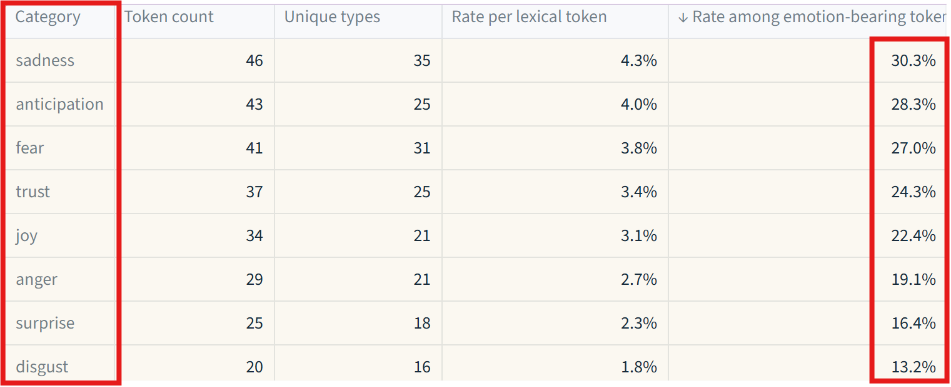
Valence is only one dimension of emotional language. When “The Raven” is examined using named-emotion associations, the darker profile becomes easier to recognize. Negative sentiment associations slightly outnumber positive ones, accounting for approximately 6.56 percent and 6.01 percent of all lexical tokens, respectively. Among the eight named emotions, sadness has the highest association rate, followed closely by anticipation and fear.
The leading sadness contributors include “leave,” “sorrow,” “darkness,” “devil,” “grim,” and “lie.” Fear is supported by words such as “sorrow,” “darkness,” “devil,” “ghastly,” and “grim.” Anger and disgust also appear, though at lower rates.
At the same time, joy and trust do not disappear. “Angel,” “fancy,” “visitor,” “god,” “radiant,” “word,” and “prophet” carry associations with those categories. Their presence is not evidence that the speaker is joyful or trusting. They reflect the poem’s mixture of sacred language, memory, longing, speculation, and loss. The emotion-intensity results reinforce this pattern. Sadness and fear have among the highest average intensities, but joy, trust, anticipation, anger, disgust, and surprise are all represented. “The Raven” is not emotionally simple. It moves through curiosity, amusement, hope, dread, grief, anger, and despair.
The valence average flattens that movement. The wider emotional profile begins to restore it.
A Completely Different Sentiment Tool Sees a Different Poem
VerseVAD also includes VADER sentiment analysis as a separate point of comparison. VADER assigns “The Raven” a compound sentiment score of -0.9918, which falls decisively within its negative range. Its raw categorization identifies 12.5 percent of the text as negative, 8.7 percent as positive, and 78.8 percent as neutral. That large neutral proportion should not be mistaken for emotional neutrality. It mostly reflects words that do not carry direct polarity under VADER’s rules.
The contrast is striking. The normative VAD lexicon produces a mean valence of 0.525, while VADER produces an overwhelmingly negative compound score. Neither result should be crowned the true emotional reading of the poem. The systems are doing different jobs. Normative VAD analysis averages ratings attached to matched words and phrases. VADER uses a polarity lexicon with rule-based adjustments and was originally developed for social-media text.
VADER may capture some contextual polarity that a simple lexical mean misses, but it was not designed to interpret nineteenth-century poetry, dramatic speakers, symbolism, or accumulating refrains. Its strongly negative result feels more intuitive, but intuitive agreement does not make it infallible. The disagreement is the useful part. It shows how strongly a computational result depends upon the question being asked and the method used to ask it.
The Lexicon Cannot Score What It Does Not Recognize
Coverage also matters. The VAD analysis matched about 78 percent of the poem’s lexical tokens in its broad view, with stronger coverage in the content-focused analysis.
Several important terms were not matched, including “Lenore,” “Aidenn,” “nepenthe,” “surcease,” “Pallas,” “Seraphim,” and “quoth.” Some are proper names, some are archaic, and some belong to the poem’s deliberately elevated vocabulary.
These are not trivial omissions. Lenore is the emotional center of the poem, yet her name contributes no direct valence score. Aidenn and nepenthe represent the speaker’s impossible hopes for reunion and relief, but the lexicon does not rate them. The surrounding words may still register, but part of the poem’s emotional vocabulary remains outside the dataset.
An unmatched word is not neutral. It is missing evidence. This is why VerseVAD reports coverage rather than quietly assigning unmatched terms a middle value. The score describes the language the resource could evaluate, not every meaningful element in the poem.
So, Is “The Raven” Positive?
No. At least, that is not what the analysis tells us.
The result tells us that the poem’s matched lexical valence sits slightly above the midpoint. It also tells us that the poem contains strong negative contributors, that sadness and fear are prominent in its emotion profile, and that another rule-based sentiment method reads the complete text as intensely negative. More importantly, the analysis helps explain how Poe creates darkness without relying exclusively on negatively rated words. He surrounds loss with beauty. He invokes angels, heaven, hope, memory, radiance, and the possibility of relief, only to take those possibilities away. The language of consolation becomes part of the machinery of despair.
That is not a failure of the poem, and it is not necessarily a failure of the lexicon. It is a reminder that literary tone is produced through relationships among words, not merely by averaging them. “The Raven” feels darker than its mean valence because readers understand absence, negation, symbolism, narrative development, sound, repetition, and dramatic context. We know that the radiant maiden is dead. We know that hope is being raised only to be denied. We know that “nothing more” does not mean abundance simply because the word “more” has a positive rating.
VerseVAD does not replace that knowledge. It gives us a way to see where the knowledge enters. A surprising result is not always an answer. Sometimes it is the moment when the interesting reading begins.