William Carlos Williams’s “The Red Wheelbarrow” is a natural place to begin experimenting with VerseVAD. It is short enough to see almost every analytical decision clearly, familiar enough that many readers arrive with an existing impression of it, and deceptively simple in a way that raises an important question for computational analysis: what exactly do we mean when we call a poem “easy”?
On the surface, there is very little here to slow a reader down. The poem consists of sixteen words arranged across eight short lines and four stanzas. Its vocabulary is mostly ordinary. Its central images are physical and recognizable: a wheelbarrow, rainwater, and chickens. Nothing about the language looks especially dense, archaic, or specialized.
Yet the poem has remained open to interpretation for more than a century. We can read every word without difficulty and still wonder what, precisely, “depends” upon the scene Williams gives us. The poem’s language is accessible, but its significance is not fully explained. That distinction—between being easy to process and easy to exhaust—is one of the reasons “The Red Wheelbarrow” makes such a useful first case study.
A Very Small Poem
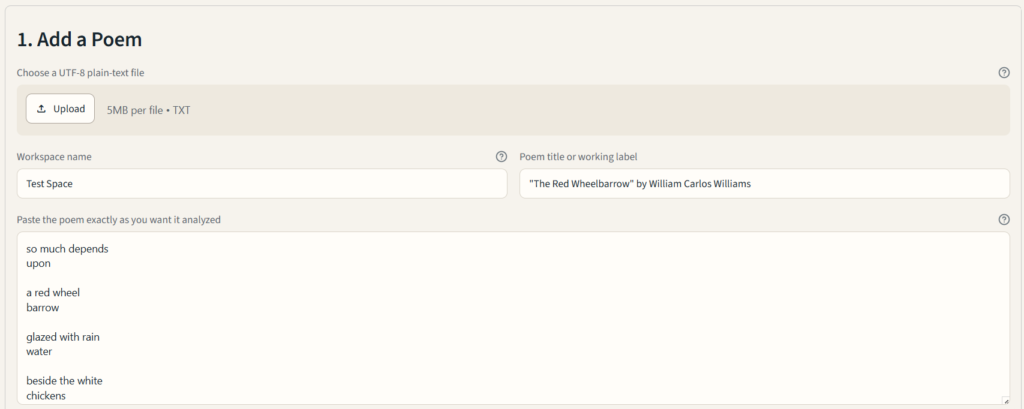
Before looking at its emotional or lexical profile, it helps to appreciate just how compressed the poem is. VerseVAD identifies sixteen word tokens and sixteen unique word types. In other words, no word is repeated. The poem averages only two words per line and approximately 2.4 syllables per line.
Those numbers confirm something we can already see on the page: Williams gives each small piece of language an unusual amount of space. Phrases that would normally pass quickly inside a sentence are divided and slowed by the line breaks. Even individual compound ideas are separated. The wheel and barrow appear across different lines, as do rain and water. The language itself is not difficult, but its arrangement asks us to notice each component.
The absence of repeated words also means that the token-weighted and type-weighted results are identical in this particular analysis. Token weighting normally allows repeated words to exert more influence over a poem’s profile, while type weighting counts each unique word only once. Here, every word already appears once, so the two approaches produce the same result.
This makes the poem a relatively clean demonstration of the analytical process. We do not need to ask whether a refrain or heavily repeated word is pulling the averages in a particular direction. Each word contributes once, and the poem’s profile emerges from the vocabulary as a whole.
A Calm Emotional Profile
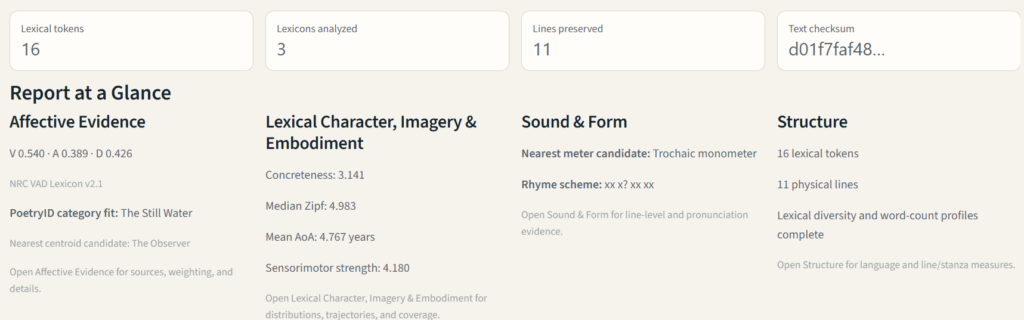
The poem’s average VAD scores are 0.540 for valence, 0.389 for arousal, and 0.420 for dominance. VerseVAD matched thirteen of the poem’s sixteen words to the selected VAD lexicon, producing a match rate of 81.2 percent. The unmatched words were “a,” “the,” and “white.”
Taken together, the scores suggest moderately positive language with relatively low emotional activation and moderate-to-low dominance. That seems broadly consistent with the poem’s restrained surface. There is no obvious crisis, declaration, argument, or emotional outburst. The scene is quiet. The poem looks closely at ordinary objects rather than naming a feeling directly.
The low arousal score is especially fitting. Even though the opening tells us that “so much depends” upon what follows, the poem does not build urgency through violent, frantic, or highly energized language. Its significance is asserted quietly. Williams creates emphasis through compression and placement rather than through emotionally intense vocabulary.
The moderate valence score is also worth noticing. The poem is not filled with overtly positive words such as joy, love, or beautiful, but neither is its vocabulary especially negative. Color, water, and the physical objects of the scene create a largely neutral-to-gentle emotional field. The poem’s emotional effect comes less from explicit feeling words than from the act of attention itself.
Dominance is somewhat more difficult to translate into an immediate interpretation. The score does not suggest especially forceful, commanding, or powerful language, but the poem also does not sound openly helpless or afraid. It observes rather than conquers. It places an object before us and gives it importance without explaining or defending that importance.
VerseVAD’s PoetryID classifications reinforce that impression. Its category-based fit is The Still Water, representing moderate valence, low arousal, and moderate dominance. Its nearest-centroid fit is The Observer. These names are descriptive shorthand rather than final interpretations, but both capture something recognizable about the poem: stillness, attention, and a speaker who allows the physical scene to occupy the foreground.
When Emotion Lexicons Get Strange
The named-emotion analysis returned matches associated with anticipation, fear, trust, and disgust, with each detected category registering 33.3 percent. At first glance, this sounds far more dramatic than the poem itself. In particular, the disgust result came from the word “barrow.”
This is a useful example of why VerseVAD should not be treated as an automatic interpreter. Emotion lexicons associate words with categories based on their entries in a dataset. They do not necessarily know which meaning of a word is active in a particular poem, nor do they understand the entire scene in which the word appears. A human reader knows that Williams is describing a wheelbarrow. The word-level lexicon sees the entry it has been given.
Rather than concealing results like this, it is more useful to show them. They demonstrate why word-level output and match transparency matter. If VerseVAD simply announced that the poem contained “disgust” without showing the contributing word, a reader could easily mistake a lexical artifact for a meaningful interpretation.
The broader result is still informative: the poem contains very little direct emotional language. Its emotional effect does not depend upon naming joy, sorrow, anger, or fear. Whatever feeling the poem creates emerges through image, color, proportion, silence, and attention. The sparse and occasionally peculiar emotion matches remind us that the poem is not primarily built from conventional emotion words.
Concrete Objects, Abstract Importance
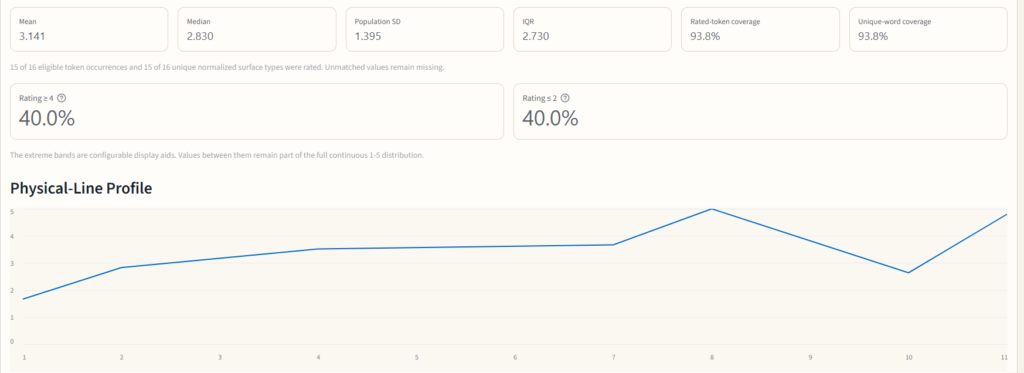
One of the poem’s most interesting results is its concreteness profile. VerseVAD reports a mean concreteness score of 3.141, with a standard deviation of 1.395. The amount of variation matters because the poem is not uniformly concrete from beginning to end.
Most of its memorable language points toward physical things. We can picture the red wheelbarrow, the rainwater, and the white chickens. Color and material objects dominate the scene. The poem gives the reader a small visual arrangement rather than a lengthy explanation.
Its opening, however, is comparatively abstract. “So much depends” makes a claim about importance, consequence, or reliance without identifying exactly what is at stake. The poem then moves from that broad, unexplained assertion into a sharply physical image.
That movement may help explain why the concreteness average is strong without being extreme. The poem’s identity is rooted in physical objects, but those objects are framed by an abstract claim. The wheelbarrow is not merely described; it is made consequential. Williams never tells us why it matters, who depends upon it, or what would happen without it.
VerseVAD can identify the poem’s balance of concrete and less concrete language, but it cannot settle the relationship between them. That remains the work of reading. Is the poem recognizing the importance of agricultural labor? Is it elevating an ordinary object through sustained attention? Is it demonstrating how perception itself creates significance? The concreteness result points toward the poem’s material world, while the opening phrase keeps that world interpretively unsettled.
Familiar Words and Early-Acquired Language
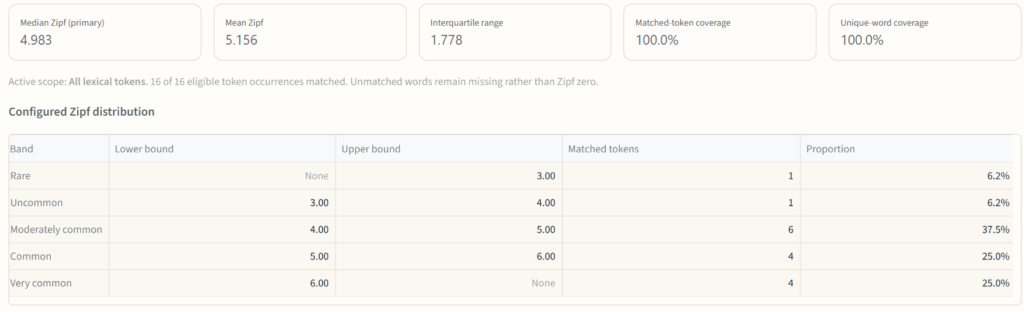
The poem’s vocabulary is not only concrete; it is also highly familiar. VerseVAD reports a mean Zipf frequency of 4.983. In practical terms, the vocabulary consists largely of words readers are likely to encounter with some regularity rather than rare, technical, or archaic terms.
The age-of-acquisition result tells a similar story. Across the broader analysis, the poem’s mean estimated age of acquisition is 4.767. Approximately 66.7 percent of its matched vocabulary falls into the early-acquired range of zero to five years, while the remaining 33.3 percent falls into the middle-acquired range of five to twelve years.
When the analysis is restricted to content words, the mean age of acquisition drops slightly to 4.679. Seventy percent of the matched content vocabulary is early-acquired, and thirty percent is middle-acquired. There are no late-acquired words dominating the poem’s lexical profile.
These results help explain why the poem is immediately readable at the word level. Williams does not ask the reader to decode specialized terminology or historically distant diction. The poem’s difficulty, such as it is, does not come from unfamiliar vocabulary.
This distinction matters because literary difficulty can take several forms. A reader may struggle because the words themselves are rare. A sentence may be syntactically complicated. A poem may depend upon obscure historical knowledge or dense allusion. It may also use very ordinary words while refusing to make their larger relationship explicit.
“The Red Wheelbarrow” belongs largely to that final category. Its words are accessible. Its image is clear. The unresolved question is why this image carries so much weight.
Measuring Poetry Reading Ease
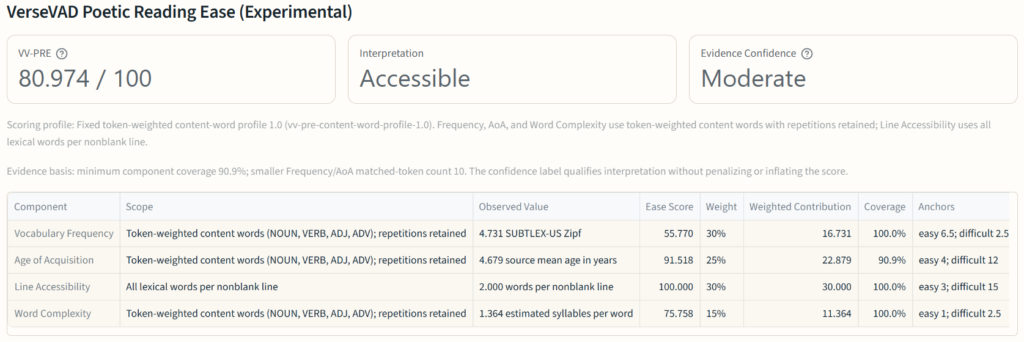
VerseVAD gives the poem a Poetry Reading Ease score of 80.974, placing it toward the accessible end of the VV-PRE scale. Traditional measures also rate it as relatively readable: its Flesch Reading Ease score is 74.270, while its Flesch-Kincaid Grade is 6.875.
In this case, the traditional measures and VV-PRE broadly agree. That is not always true with poetry. Prose-based formulas can behave strangely when confronted with unconventional punctuation, sentence structure, or lineation. A poem written as one long grammatical sentence may receive an extremely high grade level even when its words and lines are quite approachable.
“The Red Wheelbarrow” presents fewer problems of that kind. Its words are short and familiar, its lines contain an average of only two lexical words, and its content words average approximately 1.364 syllables each. Pronunciation coverage is complete, meaning VerseVAD found pronunciation data for every word in the poem.
The VV-PRE score combines several kinds of accessibility rather than relying on sentence length alone. Its components include word frequency, age of acquisition, line accessibility, and word complexity. For this poem, those signals point in the same general direction: familiar vocabulary, early-acquired words, short lines, and relatively simple word forms.
The result should not be interpreted as an estimate of the poem’s artistic sophistication or the age of reader capable of understanding everything it might mean. It is a measure of linguistic reading ease. A reader can move through the vocabulary and line structure without much decoding effort. That leaves more attention available for the poem’s arrangement, imagery, and unanswered questions.
This is exactly the distinction VV-PRE is meant to preserve. A poem can be linguistically accessible without being interpretively shallow. In fact, Williams demonstrates how much mystery can be created from words that almost any reader already knows.
What the Analysis Helps Us See
Taken together, the results describe a poem that is short, familiar, concrete, calm, and emotionally restrained. Its words are generally common and early-acquired. Its lines are exceptionally brief. It contains little direct emotional labeling, and its strongest lexical feature is its movement into the physical world of objects, color, and water.
None of those findings is especially shocking on its own. Readers do not need software to notice that “The Red Wheelbarrow” is short or that it uses ordinary words. The value of the analysis lies partly in giving those impressions a clearer structure. VerseVAD allows us to distinguish familiarity from concreteness, emotional activation from positivity, and linguistic accessibility from interpretive simplicity.
It also makes comparison possible. Once the same measurements are applied to another poem, we can ask more precise questions. How much less familiar is the vocabulary of a Shakespearean sonnet? Does a Dickinson poem use similarly accessible words while producing a different emotional profile? Is Williams unusually concrete compared with other Imagist poets or with his own larger body of work?
A single score rarely becomes meaningful in isolation. Its value grows when we can place it beside another poem, another collection, or a larger corpus. This first walkthrough establishes a baseline: a poem whose language is highly accessible, whose imagery is strongly material, and whose emotional energy remains quiet.
What the Numbers Leave Alone
After all of these measurements, the poem still has not told us what depends upon the wheelbarrow.
That is not a failure. It is the boundary between describing the language and interpreting the poem. VerseVAD can show that the vocabulary is familiar, the arousal is low, and the imagery is concrete. It can identify the poem’s short lines and its sparse emotional lexicon. It cannot determine why Williams selected this scene, what the wheelbarrow represents, or why generations of readers have continued to pause over sixteen ordinary words.
Those questions require attention to form, history, context, and human experience. The split compounds, the white space, the visual contrast between red and white, the relationship between labor and landscape, and the opening assertion of dependence all extend beyond a lexical average.
Computational analysis is most useful when it returns us to those details. It does not need to decode the poem to contribute to our reading. Sometimes its role is simply to clarify the conditions under which the poem creates its effect.
“The Red Wheelbarrow” is easy to read, but not easy to finish thinking about. VerseVAD helps us see that those two facts are not contradictory. They may be the central achievement of the poem.