A Writing Space Built Around Revision
VerseVAD Writing Studio is the writing and revision environment in the VerseVAD suite. It is designed for poets and other literary writers who want to draft in a simple workspace, examine selected patterns in their language, and make deliberate revision choices without handing the writing itself over to a generative system.
Writing Studio does not write for you.
It gives you a place to write, then offers selected VerseVAD evidence that may help you notice something you want to keep, question, strengthen, or change. The final decisions remain with the writer.
Write First, Analyze Second
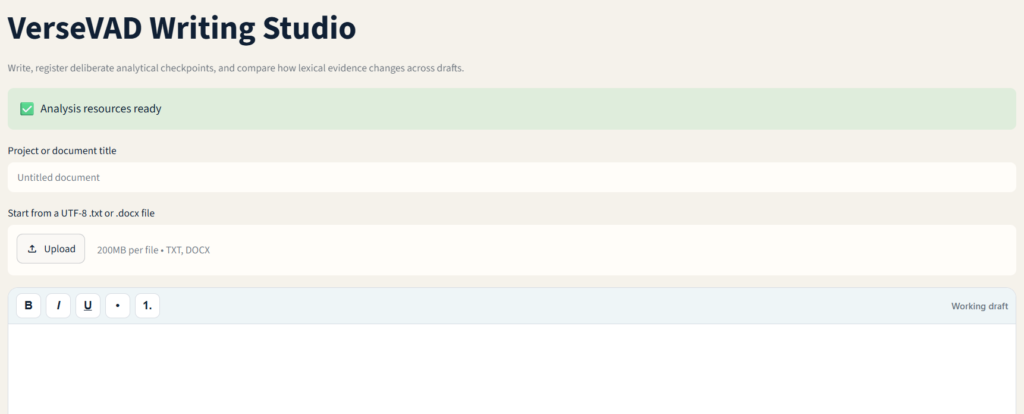
Writing Studio begins as a text editor.
You can draft freely without analytical results appearing beside every sentence or interrupting the writing process. When you are ready, you can register the current version and analyze it.
That separation is intentional.
Writing and analysis are different modes of attention. Constant feedback can make it difficult to stay inside a draft, so Writing Studio keeps the editor focused until the writer actively asks to examine the text.
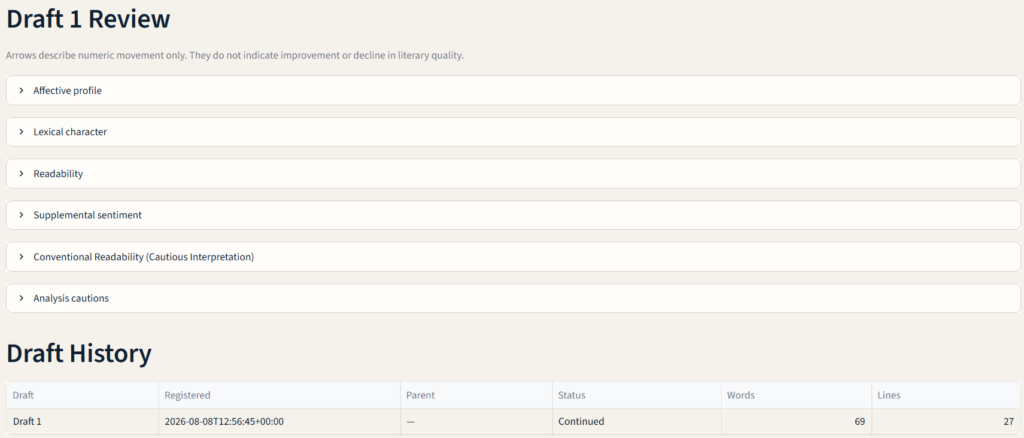
Once analysis begins, the current draft remains visible but becomes read-only while the results are reviewed. You can then decide whether to keep moving forward from that version or return to an earlier one.
Analysis as a Revision Tool
Writing Studio uses selected methods from the broader VerseVAD methodology to help writers examine patterns in their own language.
Depending on the active analysis tools, a writer may be able to explore qualities such as valence, arousal, dominance, concreteness, lexical frequency, age of acquisition, emotional association, and other measurable features of the draft.
These results are not recommendations.
A low-arousal passage does not need to become more energetic. An abstract poem does not need more concrete nouns. A repeated word does not automatically need to be removed. A difficult word is not necessarily a problem.
The value of the analysis is that it can make a pattern visible enough for the writer to decide whether that pattern is intentional.
Revision Without Automation
Writing Studio is deliberately different from generative writing tools.
It does not offer to finish a line, rewrite a stanza, imitate a voice, or generate a replacement poem. It does not treat revision as a process of accepting machine suggestions.
Instead, it presents evidence and leaves the creative response open.
A writer might notice that a passage they intended to feel tense is lexically calmer than expected. They might discover that a supposedly simple section contains substantially less familiar vocabulary than the rest of the piece. They might realize that one emotional association is being carried by only a handful of repeated words.
What happens next belongs to the writer.
You may revise the passage. You may decide the measurement is missing something important. You may keep the text exactly as it is.
All three are valid outcomes.
Registering Versions
Revision becomes more useful when earlier choices remain visible.
Writing Studio allows drafts to be registered as versions so that the writer can make changes without losing the state of the text that came before.
After analyzing and revising, you can keep the new version or return to an earlier registered version. This makes it possible to experiment more freely, especially when a revision changes the character of a poem in ways that are difficult to evaluate immediately.
The version history is not intended to turn writing into software development. It is simply a way to preserve meaningful stages of the work.
Sometimes the sentence you deleted twenty minutes ago really was better. Writing Studio would rather let you find that out without archaeology.
Keeping the Draft in View
Analysis results appear alongside the writing workflow rather than replacing it.
The text remains central to the workspace so that a writer can move between measured evidence and the actual lines that produced it. This helps prevent the analysis from becoming detached from context.
A score may look unusual in isolation. The draft itself often explains why.
Words behave differently inside syntax, metaphor, repetition, negation, sound, and dramatic context than they do in a lexicon. Writing Studio is built with that limitation in mind. The analytical evidence is there to direct attention, not to override what the writer can already hear and see in the work.
A Minimal Writing Environment
Writing Studio is intentionally focused.
It is not designed to compete with full word processors, publishing systems, layout software, or project-management platforms. The editor exists to support drafting and revision within the VerseVAD methodology.
The interface keeps the essential tools close at hand, including project controls where supported, analysis, version history, and the current text.
The aim is to create enough structure to support revision without surrounding the writer with controls that have nothing to do with the work.
Local and Cloud Versions
VerseVAD Writing Studio is available both locally and in the cloud.
The local version is designed for writers who prefer to keep their work and analysis on their own computer. It can be used without transmitting drafts to an external AI service.
The cloud version offers access through a web browser without requiring local installation. Its project and session behavior is designed around the hosted environment, so writers should use the available save controls when they want work to persist beyond the current session.
Both versions share the same basic purpose: provide a focused place to draft, examine, revise, and decide.
Privacy and Creative Ownership
Writing can be unfinished, private, personal, or simply not ready to leave the writer’s hands.
VerseVAD takes that seriously.
The local Writing Studio processes the text on the user’s own computer and does not send the draft to an external generative AI system. The program only works with material the writer deliberately enters or opens.
Writing Studio also does not claim authorship over the text. The words belong to the writer.
The analytical methods may describe selected features of those words, but they do not create the work and do not determine its value.
Who Writing Studio Is For
Writing Studio is intended for writers who are curious about what computational evidence might reveal during revision.
A poet might use it to examine how the emotional texture of a draft changes between versions. A student writer might explore whether a passage is more concrete or abstract than expected. A writer preparing a performance piece might look at lexical intensity or repetition from another angle.
It can also be useful for writers who simply want a clean drafting environment with a lightweight version history and the option to analyze only when they choose.
No computational background is required.
What Writing Studio Does Not Do
Writing Studio does not generate poems, suggest what you should write next, or judge whether a draft is good.
It does not tell you which words to replace. It does not optimize a poem toward a target score. It does not assume that higher valence, greater concreteness, more familiar vocabulary, or any other measurable quality is inherently better.
Creative writing does not have a correct numerical destination.
The purpose of the analysis is to make choices more visible, not to make those choices for you.
Write, Notice, Revise
Writing Studio is built around a simple cycle.
Write the draft. Analyze it when you are ready. Notice what the evidence reveals. Decide whether it matters. Revise if you want to. Compare the new version with the one that came before.
Then return to the writing.
VerseVAD Writing Studio is not interested in replacing the writer’s instincts. It is interested in giving those instincts another surface to push against.