A Guided Space for Reading More Closely
VerseVAD Reading Lab is the reflective reading environment in the VerseVAD suite. It is designed for readers, students, teachers, and anyone who wants to slow down, make an initial judgment about a poem, and then compare that judgment with computational evidence.
Rather than beginning with scores, Reading Lab begins with the reader.
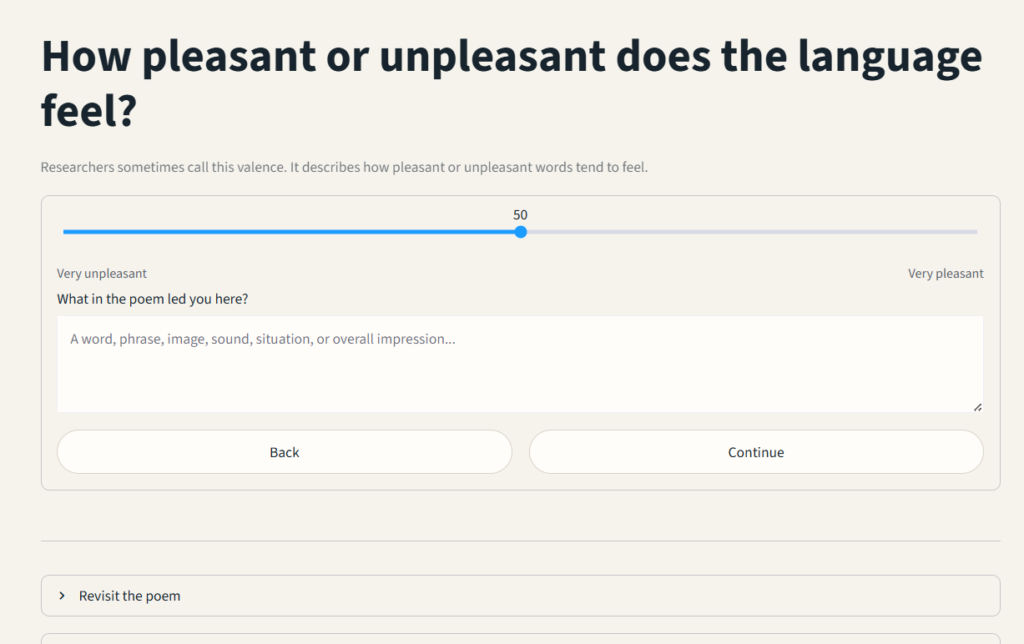
Before the poem is analyzed, you are asked to predict some of its qualities. How positive or negative does the language feel? How activated or calm? How concrete? How familiar does the vocabulary seem? Which sensory or motor domains feel most present?
Only after those predictions are made does Reading Lab reveal the measurements.
The point is not to determine whether the reader was right or wrong. The more interesting question is often: Why did I expect this poem to look different from the way it actually measured?
Prediction Before Measurement
Most computational tools begin by giving the user an answer.
Reading Lab deliberately reverses that order.
You first read the poem without seeing the analysis and make a set of predictions based on your own experience of the text. Those predictions are then compared with VerseVAD measurements, allowing you to see where your impressions align closely with the lexical evidence and where they diverge.
A difference is not treated as a mistake.
If a poem feels deeply negative but its average lexical valence is closer to neutral, that disagreement may point toward negation, irony, narrative context, repetition, metaphor, or words whose general associations change dramatically inside the poem. If the vocabulary feels difficult but its measured frequency is relatively high, the challenge may lie somewhere other than word familiarity.
Those gaps are often where the most interesting reading begins.
Different Reading Profiles
Reading Lab includes several reader profiles so that the experience can meet readers at different stages.
Current profiles include:
- General Reader
- Primary School
- Secondary School
- Undergraduate
- Advanced Academic
The underlying analysis remains grounded in the same VerseVAD methodology, but the reflection prompts change according to the selected profile.
A younger reader may be asked to notice a striking word or describe how a result changed their understanding of the poem. An advanced reader may be invited to think more explicitly about lexical norms, context, interpretive tension, or methodological limitations.
The goal is not to simplify the poem. It is to make the questions appropriate to the reader.
Compare What You Expected with What You Found
After analysis, Reading Lab places your predictions beside the measured results.
The comparison is designed to show both agreement and difference. Rather than simply labeling a prediction correct or incorrect, the interface helps make the size and direction of the difference visible.
You may find that your sense of valence was very close to the lexical measurement while your expectation for arousal was substantially different. You may predict highly concrete language and discover a larger proportion of abstract vocabulary than expected. You may assume that a poem uses rare words when its vocabulary is actually relatively familiar.
Each of these becomes a prompt for another look at the poem.
Reflection Is Part of the Analysis
Reading Lab does not stop when the measurements appear.
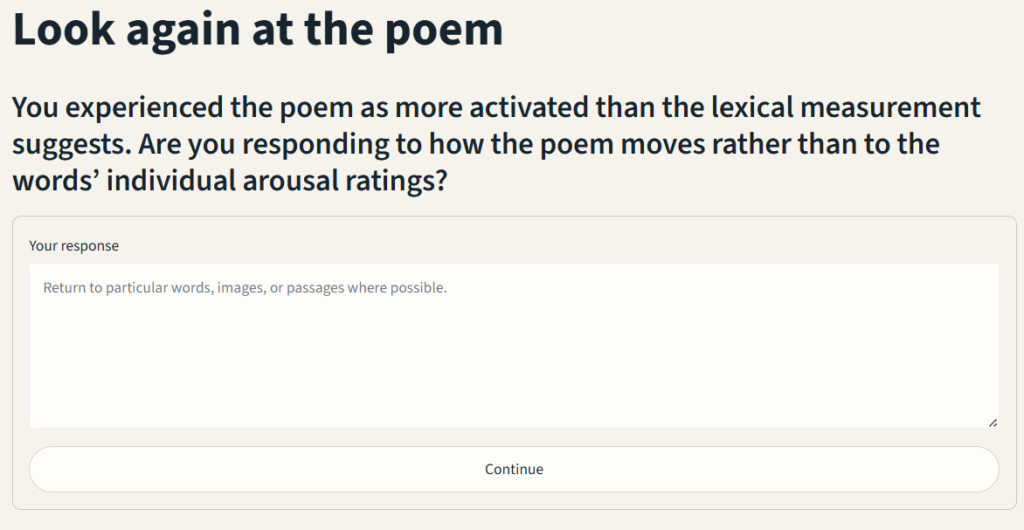
The next stage asks you to reflect on the relationship between what you expected and what the evidence showed. Prompts are drawn from the selected reader profile and respond to whether a prediction was higher than, lower than, or close to the measured result.
This is one of the central ideas behind Reading Lab.
The value of a computational result is not only the number itself. It can also reveal something about the reader’s expectations, assumptions, attention, and interpretive habits.
A surprising result may lead you to notice a repeated word you had overlooked, a contrast between imagery and emotional tone, or a difference between what a poem says and how it makes you feel.
Interactive Annotation
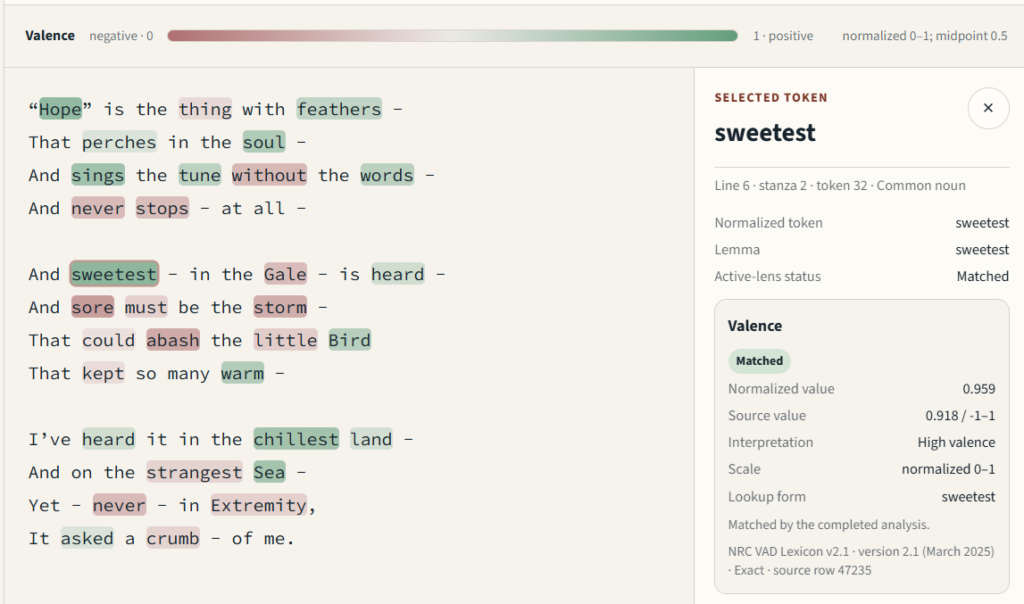
Reading Lab includes Interactive Annotation so that readers can move from summary measurements back into the poem itself.
Selected evidence can be displayed directly on the preserved text, making it possible to examine where particular lexical patterns occur. Depending on the active layer, readers can explore features such as valence, arousal, dominance, concreteness, frequency, age of acquisition, emotional associations, sensorimotor evidence, and part of speech.
The scope can also be narrowed from all lexical tokens to stopword-excluded or content-word-only views.
Selecting a word or matched expression reveals the evidence behind its annotation. This makes it easier to understand how a poem-level score was constructed and, just as importantly, to notice when the lexical evidence does not fully explain what the word is doing in context.
The annotation is a guide back into the text, not a replacement for reading it.
From First Impression to Second Reading
Reading Lab is built around movement.
You begin with an unaided reading. You make predictions. You see the measurements. You reflect on where they agree or disagree. Then you return to the poem with new questions.
That return matters.
A first reading may be shaped by atmosphere, sound, memory, imagery, or a single emotionally powerful moment. The computational evidence may reveal that the broader lexical pattern is different from what that first impression suggested.
Neither perspective automatically cancels the other.
Instead, Reading Lab asks what the relationship between them can teach us.
A Reading Record
At the end of the experience, Reading Lab can create a Reading Record that brings together the different stages of the session.
The record can include the poem, the reader’s predictions, the measured results, areas of agreement and disagreement, selected evidence, reflection responses, and a synthesis of the reading process.
It is intended to preserve the path of the reading rather than simply produce a final score.
That makes it useful for individual reflection, classroom work, discussion, or revisiting a poem later and seeing how your response has changed.
Designed for the Classroom, but Not Only the Classroom
Reading Lab can support teaching at several levels, but it is not limited to formal education.
A teacher might use it to help students distinguish between personal response and lexical evidence. A student might use it to explore why a poem feels more difficult or more emotionally intense than expected. A general reader might simply enjoy discovering which parts of their first impression are reflected in the measured language and which are not.
The guided structure is meant to make computational literary analysis approachable without requiring prior technical knowledge.
You do not need to understand the mathematics behind every measure before using the tool. The methodology remains available for readers who want to go deeper.
Session-Based by Design
Reading Lab is cloud-only and session-based.
It is intended as a temporary reading environment rather than a project-management system. There is no saved-project library, and the reading session is not designed to persist indefinitely.
This keeps the experience focused on the poem currently in front of you.
Users who need deeper analysis, persistent research workflows, corpus comparison, or full audit exports can move into VerseVAD Analyze, while Reading Lab remains centered on the experience of reading and reflection.
What Reading Lab Does Not Do
Reading Lab does not grade your interpretation.
It does not determine whether you understood the poem correctly, tell you what the poem means, or treat disagreement with the computational measurements as failure.
It also does not attempt to predict your emotions or replace your response with a numerical one.
The measurements describe selected features of the language. Your response describes your experience of reading it.
Reading Lab is interested in what happens when those two forms of evidence meet.
Read, Compare, Return
The central question in Reading Lab is not simply, What did the computer find?
It is:
What did you expect to find, what did the evidence show, and what does the difference make you notice now?
That cycle turns computational analysis into a reading practice rather than an answer machine.
Read the poem. Make a prediction. Look at the evidence. Ask why. Then read it again.