
Computational Poetry Analysis for Close Reading, Comparison, and Research
VerseVAD Analyze is the core analytical environment in the VerseVAD suite. It is designed for readers, students, teachers, poets, and researchers who want to examine measurable patterns in poetic language without treating those measurements as substitutes for interpretation.
The program brings together lexical, affective, psycholinguistic, structural, phonological, and readability analysis in one workspace. Users can study a single poem closely, compare texts, explore larger corpora, and inspect the evidence behind the results.
VerseVAD Analyze is available both locally and in the cloud.
What VerseVAD Analyze Does
VerseVAD Analyze examines features of poetic language that can be described computationally. Depending on the analysis, this may include valence, arousal, dominance, emotional associations, concreteness, lexical frequency, age of acquisition, sensorimotor language, readability, pronunciation, syllable structure, meter, rhyme, and other formal or lexical patterns.
These measures do not define the poem. They offer additional evidence about how its language behaves.
A result might confirm something that already seemed obvious in a close reading. It might complicate an initial impression. It might reveal an unexpected cluster of words, a difference between two poems that otherwise feel similar, or a pattern that becomes visible only when the text is examined systematically.
The goal is not to settle interpretation. It is to give readers more places to begin.
Analyze a Single Poem
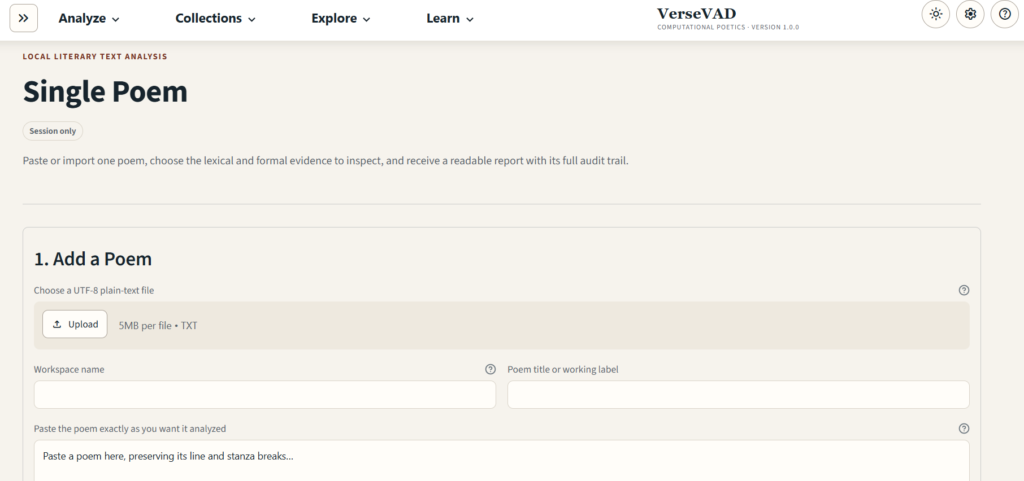
The single-poem workspace is designed for close analysis.
Users can enter a poem and move through different areas of evidence, including affective language, lexical characteristics, readability, sound, structure, and poetic form. Results are organized into sections so that a reader can focus on one question at a time rather than treating the poem as one enormous collection of statistics.
For compatible lexical measures, VerseVAD allows users to change analytical scope and weighting, making it possible to examine all lexical tokens, exclude standard stopwords, or focus more narrowly on content words. Token-weighted and type-weighted views allow repeated language and vocabulary diversity to be considered separately.
The selected view carries through the relevant report sections so that the analysis remains coherent rather than becoming a collection of disconnected settings.
Interactive Annotation
Interactive Annotation brings the analysis back onto the poem itself.
Instead of reading only summary scores and tables, users can view selected evidence directly on the preserved text. Words and matched expressions can be examined through lenses such as valence, arousal, dominance, concreteness, frequency, age of acquisition, emotional association, sensorimotor evidence, and part of speech.
The annotation scope can also be changed, allowing readers to move between all lexical tokens, stopword-excluded language, and content-word-only views.
Selecting a word or expression opens the evidence behind it. This makes it easier to see where a poem-level result comes from and to notice when lexical evidence interacts with context in unexpected ways.
Interactive Annotation is not intended to replace close reading. It is designed to make close reading more inspectable.
Compare Poems and Collections
VerseVAD Analyze is also built for comparison.
Readers can place poems beside one another and examine differences in lexical-affective profiles, concreteness, frequency, age of acquisition, readability, and other supported measures. Larger corpus workflows make it possible to explore patterns across books, poets, periods, or other collections.
Comparison is especially useful when the numbers refuse to behave the way we expect.
Two poems may have nearly identical average valence while creating radically different emotional experiences. A poem that feels difficult may use unusually common vocabulary. Another may be linguistically accessible but structurally or interpretively demanding.
Those discrepancies are often more interesting than a clean result.
Sound, Structure, and Form
Poetry is not only lexical.
VerseVAD Analyze includes tools for examining pronunciation, syllables, stress patterns, candidate meter, rhyme, internal sound relationships, line structure, stanza structure, and inherited poetic forms.
These methods are presented with appropriate caution. A meter candidate is not treated as definitive scansion, and a structural match is not presented as proof that a poem belongs to a particular form. Where confidence is limited, VerseVAD says so.
The purpose is to provide evidence that can be compared with what a reader hears and sees on the page.
Readability and Linguistic Accessibility
VerseVAD includes both traditional readability formulas and its own poetry-focused readability framework.
Traditional formulas can still be informative, but many were developed for prose and depend heavily on assumptions about sentence length, syllable counts, and conventional syntax. Poetry often disrupts those assumptions.
VerseVAD Poetry Reading Ease, or VV-PRE, approaches accessibility differently by combining lexical frequency, age of acquisition, line accessibility, and word complexity under a fixed, documented profile.
VV-PRE is intended to estimate surface-level linguistic accessibility. It does not measure interpretive depth, literary quality, thematic complexity, or the difficulty of what a poem asks us to think about.
PoetryID and VerseMap
VerseVAD also includes exploratory tools for locating poems within broader lexical and affective spaces.
PoetryID describes a poem’s broad lexical-affective profile using combinations of valence, arousal, and dominance. These labels are not emotional verdicts or genre classifications. They are descriptive neighborhoods intended to make patterns easier to discuss.
VerseMap allows a poem to be compared with reference texts using a defined analytical profile. Similarity in VerseMap does not mean that two poems mean the same thing or share the same style. It means that they are relatively close under the particular measurements used by that map.
These tools are best understood as invitations to comparison rather than conclusions.
The Evidence Behind the Numbers
Transparency is central to VerseVAD Analyze.
Where possible, the program reports not only final values but also the evidence required to understand them. This includes match rates, coverage, denominators, scope, weighting, contributor words, unmatched terms, resource information, configuration details, and methodological cautions.
Missing evidence remains missing rather than being silently assigned a neutral or zero value.
Exports are designed with reproducibility in mind. Current-view reports preserve the settings used for the visible analysis, while complete audit exports retain deeper evidence and methodological metadata for users who need to inspect or reproduce the calculations.
A score should never require blind trust simply because software produced it.
Local and Cloud Versions
VerseVAD Analyze can be used either locally or in the cloud.
The local version runs on the user’s own computer and can operate without transmitting poem text or analysis data to an external service. This makes it especially useful for unpublished writing, sensitive texts, classroom materials, or research where local control matters.
The cloud version provides browser-based access without requiring installation.
Both are built around the same broader methodology, although deployment-specific features may differ.
Who VerseVAD Analyze Is For
VerseVAD Analyze is intended for anyone interested in examining poetic language more closely.
A researcher might use it to compare hundreds of poems. A student might use it to investigate a surprising pattern in a single text. A teacher might use it to demonstrate how different measures capture different aspects of language. A poet might use it to look at sound, diction, or lexical texture from an unfamiliar angle.
No background in programming or computational linguistics is required.
The software is designed to make these methods accessible while still showing enough of the underlying process for users who want to examine it closely.
What VerseVAD Analyze Does Not Do
VerseVAD Analyze does not tell you what a poem means.
It does not determine literary quality, diagnose an author’s emotional state, identify a reader’s response, or convert a poem into an objective score of goodness, difficulty, sadness, beauty, or importance.
It also does not generate poetry.
VerseVAD works with language that a human being has chosen to read, study, compare, or write. Its measurements describe selected features of that language. Interpretation remains with the reader.
Start with a Question
The most useful way to approach VerseVAD Analyze is not to ask what the software can tell you about a poem.
Start with what you want to know.
Why does this poem feel more intense than another? Are its words actually less common? Does the language become more concrete over time? Is repetition driving the affective profile? Does the sound pattern support what the meter candidate suggests? Why does a lexical result seem completely at odds with the reading experience?
VerseVAD Analyze can help make those questions more precise.
Then the real work begins where it always has: back in the poem.