VerseVAD has always been designed to bring readers back to the poem. Summary scores can help us identify patterns, compare texts, and test our first impressions, but the most important questions usually begin when we return to the individual words and lines. Interactive Annotation, the newest feature in VerseVAD, was created to make that return easier.
The new view places the analytical evidence directly onto the preserved text of the poem. Instead of moving back and forth between a summary report and a separate list of contributing words, readers can see patterns where they actually occur. The poem remains intact, including its line breaks and stanza structure, while selected layers of evidence are added around it.
For this first look, I am using Robert Frost’s “Stopping by Woods on a Snowy Evening,” a poem whose language feels familiar and direct while leaving plenty of room for uncertainty, tension, and interpretation.
Seeing the Evidence in the Poem
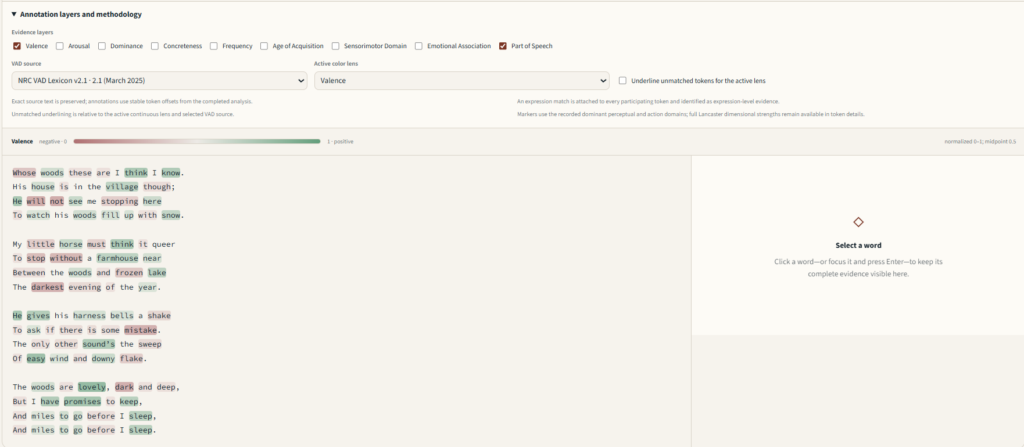
Interactive Annotation currently includes layers for valence, arousal, dominance, concreteness, frequency, age of acquisition, sensorimotor domains, emotional associations, and part of speech. Readers can turn layers on and off depending on the question they are asking.
One layer also serves as the active color lens. When valence is selected, for example, words are shaded according to their position on the negative-to-positive scale. In Frost’s poem, words such as “lovely,” “know,” and “easy” appear differently from words such as “darkest,” “queer,” and “mistake.” The shading does not tell us what the poem means, but it makes the underlying lexical pattern visible without separating the words from their poetic setting.
Changing the active lens changes the question. A concreteness view can draw attention toward physical objects and more abstract language. Frequency can show where familiar vocabulary gives way to less common diction. Age of acquisition can help identify words that may place different demands on readers. Part-of-speech markers add another layer, allowing users to examine how nouns, verbs, adjectives, pronouns, and other grammatical categories are distributed through the poem.
The feature is not intended to make every layer active at once. In most cases, the clearest approach is to select one primary lens and add only the supporting evidence that helps answer a particular question.

From a Score to Its Source
A poem-level average can conceal a great deal. Two poems may have similar mean valence while arriving there through very different combinations of words. A whole poem may appear moderately concrete even though one stanza is filled with physical imagery and another shifts toward abstract ideas. Repetition may allow a single word to exert unusual influence over a token-weighted result.
Interactive Annotation helps expose those differences.
Rather than treating the summary score as the end of the analysis, readers can see where its evidence is located. They can follow a pattern through the stanzas, notice contrasts between neighboring words, and inspect the terms that appear to be pulling a result in one direction or another. This does not remove the need for interpretation. It gives interpretation a more specific place to begin.
That is especially useful in “Stopping by Woods on a Snowy Evening.” The poem moves through woods, snow, a frozen lake, harness bells, wind, downy flakes, promises, distance, and sleep. Some of that language belongs clearly to the physical scene. Other words introduce obligation, uncertainty, inward reflection, or possible symbolic meaning. Interactive Annotation does not decide how those elements should be read together, but it makes their distribution easier to examine.
Selecting a Word
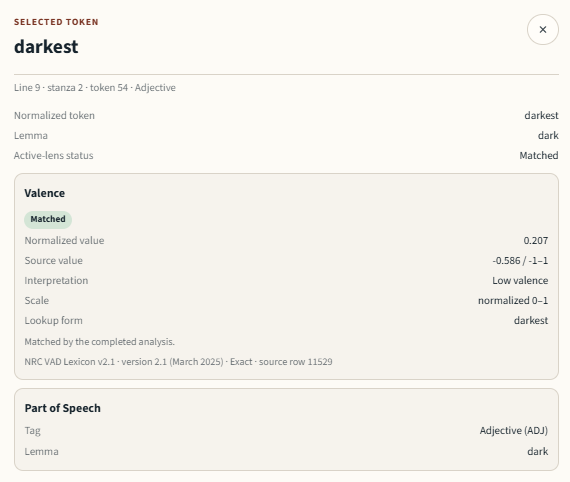
Clicking an annotated word opens its detailed evidence in the panel beside the poem. This allows the reader to move beyond the visible color and inspect the information attached to that particular token.
The details may include its lexical rating, source, matching status, grammatical annotation, and evidence from other enabled layers. This is important because a color alone can appear more certain than the underlying method really is. The detail panel gives users a way to ask why a word received its annotation, whether an observed form or expression was matched, and which analytical resource supplied the result.
It also helps users catch the moments when a lexical rating does not fit the word’s role in context. A generally positive word may describe something absent or denied. A neutral-looking word may become emotionally charged through repetition, placement, or dramatic situation. A computational annotation can identify an association, but the reader must still decide what that association is doing in the poem.
Keeping the Method Visible
Transparency has been central to VerseVAD’s development, so the annotation view also makes its methodology visible. Users can see which VAD source is active, choose whether unmatched words should be underlined, and inspect the evidence connected to individual tokens.
The exact source text is preserved, and annotations are attached through stable token positions from the completed analysis. Multiword expressions can remain identified as expression-level evidence rather than being silently reduced to unrelated individual words. When a word is not matched by the selected resource, VerseVAD can show that absence instead of pretending that the word is neutral.
These details may not be the most visually dramatic part of the feature, but they matter. An annotation is only useful when readers can understand what it represents and where it came from.
Another Way Into the Poem
Interactive Annotation is not an attempt to cover a poem in data until nothing human remains. The feature exists because poetry cannot be understood from summary statistics alone.
The colors, markers, and word details are invitations to pause. Why does one stanza contain a cluster of negatively associated words? Why does a repeated word appear differently from the surrounding language? Where does the poem move from physical description toward abstraction? Does a lexical pattern support the reading we already had, or does it complicate it?
Those questions lead back to lineation, sound, metaphor, syntax, context, and reader experience. They lead back to the poem.
That is what I hope Interactive Annotation adds to VerseVAD. It gives readers a clearer view of the evidence behind the numbers, while leaving the real work of reading exactly where it belongs.